
Dr. Kristen Otto from Moffitt Cancer Center discusses the testing that often follows a thyroid cancer diagnosis. Dr. Otto reviews the essential tests, from ultrasound and bloodwork to advanced biomarker and molecular testing, and explains how each one helps guide treatment and staging.
Dr. Kristen Otto is a Head and Neck Endocrine Surgeon and an Associate Member in the Department of Head & Neck – Endocrine Oncology at Moffitt Cancer Center. Learn more about Dr. Otto.
Related Resources


Transcript
Katherine Banwell:
What sort of testing should be done following a thyroid cancer diagnosis?
Dr. Kristen Otto:
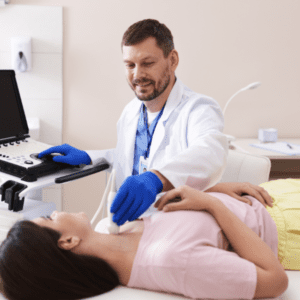
So, we generally start by classifying any given thyroid tumor or thyroid nodule with ultrasound. Ultrasound is the gold standard that we use for classifying thyroid tumors, and it actually tells us which thyroid nodules need to be biopsied and need to be further worked up and then may have a risk of being malignant.
Once we have a thyroid cancer diagnosis, it’s important to understand, of course, which type of thyroid cancer we’re dealing with. Because the most common type of thyroid cancer, as I mentioned, papillary cancer, has a very strong predilection to spread to lymph nodes in the neck. And we really need to understand if it has spread so that we can plan the best ultimate surgical procedure for the patient if that’s where we’re headed. And most of the time, that is where we’re headed.
So, ultrasound of the lymph nodes is a really important assessment tool. The other things we generally do, we like to get an understanding of the thyroid function. That comes through blood work, so we check labs, like the TSH and the free T4. Generally, having a thyroid cancer actually has no impact on thyroid function, so we expect the labs to all look normal. That can also help us to assess someone’s safety for going through surgery.
Katherine Banwell:
What about biomarker testing? Does that have a role in thyroid cancer care?
Dr. Kristen Otto:
It absolutely does, and, in fact, there’s a very standard protocol for using biomarkers. It’s a little bit of a generic term, but in thyroid nodule work-up and thyroid cancer work-up, we generally consider molecular testing or DNA, RNA testing to be part of the protocol. It helps us determine whether a thyroid nodule has a chance of being malignant or not, and then it also helps us to determine whether any particular thyroid cancer is going to be responsive to traditional therapies, such as surgery, radioactive iodine, or whether we need to maybe employ some alternative strategies. And then what is the long-term risk of recurrence in the future?
Katherine Banwell:
I imagine that staging is part of the diagnosis. How is thyroid cancer staged?
Dr. Kristen Otto:
So, interestingly, thyroid cancer is the only adult solid tumor that is actually staged based on age. So, a patient under age 55 who has differentiated thyroid cancer – so, that’s the three common types, papillary, follicular, oncocytic.
If you’re under age 55, you can only ever have stage I or II disease. And that just should kind of further drive home the point that generally, patients do quite well with these tumors. Over age 55, we have stages I to IV, and it’s really based on, has the tumor spread beyond the thyroid to either lymph nodes in the neck or to distant sites in the body?
Katherine Banwell:
How does a patient’s stage affect care options?
Dr. Kristen Otto:
It may affect care options, and it actually may not. In the highest stages, if a patient has really got tumor spread, extensively invasive tumor spread outside the thyroid gland, it actually may become something that is not surgically amenable. But in general, for almost all types of thyroid cancer, surgery is the preferred method of treatment, even if the tumor has spread beyond the thyroid, let’s say, to lymph nodes in the neck.
Or even if it has – in many cases, if it has spread to distant sites such as the lungs or bones, we still approach the main tumor with surgery so that we can then ready the patient for additional options that may help to treat the metastatic disease, such as radioactive iodine.
Katherine Banwell:
Dr. Otto, I’d like to go back briefly to biomarker testing. Is this a standard test for anyone diagnosed with thyroid cancer?
Dr. Kristen Otto:
That’s a good question, and I think it’s something that is slightly debated at this point in time. Should we be doing it for every tumor? Probably not. We’re probably not at the point where all small standard intrathyroidal papillary thyroid cancers, for instance, need biomarker testing, but anything that is behaving outside the realm of what we expect normal, we would certainly do it. The other scenario where we routinely do biomarker testing is when we do a biopsy of a nodule in the thyroid gland and we don’t get a definitive result. So, these are the so-called “indeterminate thyroid nodules.” We’re not really sure if they’re benign or malignant.
They’re atypical or they’re suspicious. In those instances, we actually routinely do biomarker testing to try to help further drill down the true risk that this thing could be cancer.
Katherine Banwell:
What questions should patients be asking about these test results that will help them in their care?
Dr. Kristen Otto:
I think it’s important if we’re going to – so, there are lots of different ways we can do biomarker or molecular testing in the thyroid gland. There are probably three widely accepted testing platforms in the country, although many institutions have their own version of these tests. These three companies that do biomarker testing for thyroid nodules have slightly different methods of testing, and so the results are not always comparable and don’t always mean the same thing institution to institution.
And the test results come out differently, so one platform might tell you exactly what mutation you have, and another platform might tell you what is your risk of malignancy? And so, it’s not always comparing apples to apples. So, I think understanding the true molecular alteration present and how that informs treatment decisions, likelihood to spread to other sites of the body, likelihood to be responsive to treatment, is an important consideration.
Katherine Banwell:
Is there a hereditary component to thyroid cancer care?
Dr. Kristen Otto:
The vast majority of thyroid tumors we do not consider to be hereditary. There are some rare genetic syndromes that may predispose someone to a slightly increased risk of thyroid cancer. The one exception in the world of thyroid cancer that we know can be hereditary is the medullary thyroid cancer that we were discussing upfront.
Even most medullary thyroid cancers are not hereditary. There’s a small subset that go along with a syndrome called multiple endocrine neoplasia type 2 syndrome. So, a very, very small subset of thyroid cancers are proven to be hereditary.