
Personalized medicine is often mentioned in cancer care—but what does it mean exactly? Dr. Barbara Ma explains personalized medicine, how it relates to a non-melanoma skin cancer treatment plan, and discusses the benefits of tailored approaches and targeted therapy.
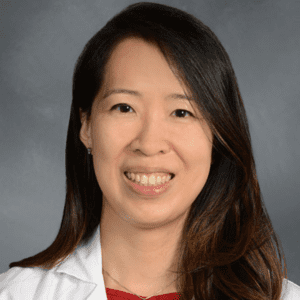
Dr. Barbara Ma, is Cutaneous Oncologist and an Assistant Professor of Medicine at Weill Cornell Medicine and an Assistant Attending Physician at New York Presbyterian Hospital. Learn more about Dr. Ma.
Related Resources


Transcript
Jamie Forward:
Dr. Ma, what does personalized treatment mean in the context of skin cancer?
Dr. Barbara Ma:
Yeah, so…when we talk about personalized medicine, we think about – there are a lot of technologies where we look at the molecular sequencing of the tumor. And I think that for the non-melanoma skin cancers, we do have pretty great treatments. But it also is personalized for you in terms of what’re the characteristics of your cancer, right?
Someone who has a squamous cell that’s on the lower leg – it might have a different treatment plan if it’s something that’s located on right ear or something like that, right? So, location. But also family history – is there a family history of some other skin cancers that make you more prone or more at risk for it? Is it something that you’d be eligible for? Let’s say if someone is not in good shape to tolerate a surgery, then there should be serious consideration for immunotherapy as a treatment plan. So, I will say that because we have more tools in the toolbox and a very strong multidisciplinary involvement for these, that actually a lot of this is personalized for the patient now.
Jamie Forward:
Sure. And are there advances in genetic or molecular testing that are helping to shape treatment decisions at all?
Dr. Barbara Ma:
Sure. So, we do think about targeted therapy. But when we look at the molecular sequencing for basal and squamous, for basal cell, we mainly talk about something called hedgehog inhibitors. Because we look for, essentially, a UV damage signature when we look at the molecular genetics. So, those are things that we do see.
The other thing that we also check sometimes is something called PD-L1 expression. But mainly that’s a marker where if we see that it’s higher, we tend to think more likely to benefit from immunotherapy. But that’s not a stopping point. The majority of patients with non-melanoma skin cancers do benefit from immunotherapy if they’re eligible for it. And that usually depends on the sizing and the staging of their non-melanoma skin cancer.