
How can you overcome barriers to getting the MPN care that’s right for you? Dr. Ghaith Abu-Zeinah discusses common challenges patients may face, including understanding their diagnosis and test results, knowing which symptoms and changes to track, recognizing when treatment may need to be revisited, and accessing specialized MPN expertise. He also shares practical strategies to help patients speak up, ask informed questions, and navigate barriers to care with greater confidence.
Dr. Ghaith Abu-Zeinah is a hematologist-oncologist and physician-scientist specializing in myeloproliferative neoplasms at the Richard T. Silver MPN Center at Weill Cornell Medicine and NewYork-Presbyterian Hospital.
[ACT]IVATION TIP
"..question the treatment options that are available or presented to you, and seek an expert opinion on what these options are, because you might hear about options that you haven't heard of initially, or you might hear a perspective that favors a treatment option that wasn't actually the preferred option in your original consultation, so I think that you need to gather more information yourself and make the decision, informed decision."
Related Resources


Transcript
Lisa Hatfield:
Hello, and welcome to this Patient Empowerment Network [ACT]IVATED Program. I’m your host, Lisa Hatfield, and today’s program is focused on staying activated with an MPN, Overcoming Barriers to Care.
This program is designed for people living with myeloproliferative neoplasms, or MPNs, and their care partners. Our goal is to help you better understand your diagnosis, recognize important changes in your health, access the expertise and resources you need, and feel more confident participating in decisions about your care.
Throughout our discussion, we’ll focus on some of the barriers that make navigating MPN care more challenging, from understanding test results and symptoms to accessing specialized care and knowing when to ask about additional treatment options. And throughout the program, listen for our [ACT]IVATION tips. Clear, actionable takeaways you can use in conversations with your healthcare team.
Joining me today is Dr. Ghaith Abu-Zeinah, Assistant Professor of Medicine at Weill Cornell Medicine and Assistant Attending Physician at NewYork Presbyterian Hospital. Dr. Abu-Zeinah is a hematologist-oncologist and physician-scientist specializing in myeloproliferative neoplasms at the Richard T. Silver MPN Center. Dr. Abu-Zeinah, thank you so much for joining us today.
Dr. Ghaith Abu-Zeinah:
Thank you for having me, Lisa. It’s a pleasure to be here.
Lisa Hatfield:
Before we begin, we also want to hear from you. Following the program, we’ll invite you to complete a brief survey that you will receive via Zoom email. Your feedback helps us understand whether these resources are useful, and how Patient Empowerment Network can better support you in the future.
Let’s start where every MPN journey begins with getting the right diagnosis. One barrier patients may face is receiving an MPN diagnosis without fully understanding what testing established it, or whether that diagnosis may need to be revisited over time. Dr. Abu-Zeinah, what tests and clinical information are typically used to confirm an MPN diagnosis, and what should patients understand about their specific diagnosis from the beginning?
Dr. Ghaith Abu-Zeinah:
So, yes, thank you for having me again, Lisa. I think this is a topic that is the focus of, really, my clinical practice, and I want to start first by introducing what MPN really means. So, having an MPN, it’s a myeloproliferative neoplasm. When we talk about MPNs, I think I’d like to kind of break that barrier first by pointing out that MPNs are blood cancers.
I think that certainly can create a bit of a sense of fear about having a cancer diagnosis. There’s obviously stigma around the word cancer, but it’s very important that patients are aware and educated of what it is and how it’s diagnosed.
So MPN again stands for myeloproliferative neoplasms. And that is really the broad term that’s used to describe three main diagnostic subtypes, essential thrombocythemia, or ET, polycythemia vera, or PV, and myelofibrosis, or MF. So, when it comes to the MPNs, what’s common across these three subtypes is the type of gene mutation that is acquired, not inherited, but acquired, that leads to the abnormal development of blood cells.
So it really comes down to identifying an abnormality in blood cells, typically with your primary care physician on an annual physical, or if there are symptoms that prompted testing, that’s number one in the criteria, is identifying abnormal blood counts. Coupled with the presence of a mutation, what we call a driver mutation for MPNs. And it’s generally one of three mutations, or three genes that are mutated. And those are the JAK2, the CALR, or C-A-L-R, and the MPL, or MPL gene.
But there is about a 10 percent of ET and MF that is triple-negative, or negative for these three mutations, and might have a mutation in a different gene that requires, really, an extended panel of gene tests. We call that a myeloid NGS, or next-generation sequencing.
So we start off with blood counts, gene mutation testing, and of course, we take the clinical presentation into account. What are the symptoms involved? Do the symptoms correlate with what we would expect with one of these conditions, or could there be something else going on?
And once we have established that these two criteria of blood counts and, you know, driver mutation are positive, the third major criteria required to establish the MPN diagnosis is findings on the bone marrow biopsy.
So as a blood cancer, it really originates from the bone marrow, and for us to know exactly what subtype we’re dealing with, we really have to confirm that the presence of the MPN in the bone marrow and determine which type it is. So that would be the third element for the three major criteria.
There are some minor criterion that help you distinguish one from the other, so when we get to the nuances of, do I have ET or do I have PV? Certainly, we know that blood counts are a big distinguishing factor, but there are some minor criteria. For instance, what is your EPO level? EPO, erythropoietin.
That can be very low in some patients with PV, but it’s not expected to be low with ET or myelofibrosis. Similarly, there are other blood tests. For instance, lactate dehydrogenase is a minor criterion in distinguishing myelofibrosis, perhaps, from ET.
It can also be elevated in PV. But really, if you’re going to remember anything out of this, I guess my [ACT]IVATION tip is to get an MPN diagnosis, you need to look at blood counts, presence of a driver mutation, and the bone marrow biopsy findings, and couple that with the clinical presentation.
Lisa Hatfield:
Okay, thank you.
Once a diagnosis is established, another barrier patients may face is understanding what all of the ongoing testing actually means. Blood counts, molecular testing, bone marrow results, and other numbers can be difficult to interpret, and patients may not know which changes matter most.
So, Dr. Abu-Zeinah, what should patients understand about the tests used to monitor an MPN, and how can they have more meaningful conversations with their care team about what those results mean for their individual disease?
Dr. Ghaith Abu-Zeinah:
Yeah, so one thing I’d like to kind of bring up in these conversations, is I’d like to know from my patient, you know, how do they feel about the information? In some, your thinking knowledge is power, and I’m all for knowledge is power. Some prefer that ignorance is bliss.
And so, it’s really the question to the patient is really, how much do you want to know, and how closely do you want to be monitoring your own blood values, bone marrow findings, and does it cause more anxiety to know all these details, or does it help you feel like you’re in control of what you’re dealing with and what you want to ask for if you actually know more information? So, once we’ve established that in a conversation of how involved, really, do you want to be.
You know, we talk about some of the key elements of the disease and what distinguishes the burden of disease and the things to focus on. So, what are the tests that matter? I think blood count seems to be kind of the easiest test to follow.
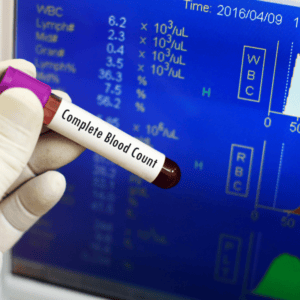
It may not be the most important test, but it is certainly the easiest test that we do almost on every visit. We have a blood count that looks at how high your platelets are, how high your hemoglobin or hematocrit is, and we often use these numbers as a target for therapy.
So if we are starting a treatment, is our goal to control the numbers and the platelets, or the hemoglobin hematocrit? You know, evidence-based medicine and studies have indicated that controlling these counts actually does matter, because keeping your hematocrit, if you have PV, under 45 percent, improved survival, free of cardiovascular and thrombotic events.
Similar is true for platelet cut-offs, perhaps, you know, 600, if you look at one of the older studies, on platelet count control, although, many of us, and personally, I would argue for normalizing platelet counts, so the cutoff would be 450, where it’s between high and normal. So, following your blood counts is sort of a given.
But we also have to acknowledge the limitations there, meaning that sometimes you derive benefit in many other ways, but maybe the counts aren’t perfect. And sometimes the counts are controlled, but there are factors that might be of concern.
And so what are some additional tests you want to focus on beyond blood counts? Well, perhaps, keep a close track of your symptoms, and you might feel that some of your symptoms are “age-related.” Maybe I’m aging. And that’s not a satisfying explanation. I think that is sort of the diagnosis of exclusion, if you’ve really tried your best and you can’t find anything.
But, you know, stay in tune with what your body’s telling you. You’re more fatigued than you typically are, and maybe don’t compare to yesterday, compare to how you were last year. Look at your photos, what kind of exercise and activity were you doing? Were you traveling a lot? How, you know, are you more sedentary now than you were before?
Are you limited by significant fatigue? So, that is something that we rely heavily on you, the patient, to tell us. And we do have tools to capture that. We have the MPN symptom assessment form, where you put down the score on that, and we trend that over time. So you could follow your own scores if you want to. You could have a diary, or there’s actually electronic versions of this. There’s apps on the phone to do that. So if you really want to take it that step further, is, you know, track your symptoms, you can.
So, symptoms, blood counts, and then in the office, we examine the spleen every, essentially on every visit to determine if there’s been an increase or decrease. And if you start off with an enlarged spleen, you want to track how that’s changing. That does have some relevance to the overall, you know, disease burden, potentially to the prognosis, so it’s important to track that as well.
Other things, you know, such as molecular findings, you have a mutation, you could track how what the percentage on that mutation is, the allele frequency, as we refer to it, or allele burden. You could track the driver mutations, but if there are other mutations, those can also be tracked.
And then certainly bone marrows, if you do have more than, you know, your baseline diagnostic bone marrow, you could monitor those, but we really don’t make it a rule to do a marrow at a specified interval to track the changes unless you’re on a clinical trial. And in those cases, we do marrows at baseline and during the course of therapy, and we follow things within the bone marrow. That include the degree of fibrosis, the level of cellularity, the morphology of the blood cells in the bone marrow. And so really, there’s a lot of things you can track and, you know, that by itself can be a whole conversation.
So my [ACT]IVATION tip on this one here is, what are some tests that are meaningful to track that would include your CBC, your symptoms, your spleen size, and then potentially the molecular or allele burden, and if applicable, bone marrow features.
Lisa Hatfield:
Okay, thank you. Another barrier in MPN care is that blood counts may look stable even when a patient does not feel well. Some people continue to experience fatigue, itching, night sweats, brain fog, abdominal discomfort, or other symptoms that may not be fully reflected in their lab results.
Dr. Abu-Zeinah, how should symptoms and quality of life factor into evaluating how well an MPN is being managed?
Dr. Ghaith Abu-Zeinah:
Yeah, so this is a very important point. You know, if you have a disease and you attribute the symptoms to the disease, you are treating the disease with the goal of both improving symptoms and blood counts. Yet in in not even some, in many instances, we have control of blood counts, but we still have symptoms. So, I think, again, this is one of those two possibilities in my mind.
One being, if your disease is truly adequately controlled, perhaps your symptoms could be due to another process. So, have we done a thorough enough evaluation for other things that could explain your symptoms? And one thing that tends to actually happen quite commonly, at least in PV, is that patients might have hematocrit control, platelet control, white cell control, but be very iron-deficient, because in the process of getting there, they may have had a lot of phlebotomies that drained them of iron.
And the fact that, you know, the patient’s iron-deficient can induce a lot of symptoms that might even mimic disease-related symptoms, whether it be fatigue, brain fog, just weakness, even neuropathy symptoms sometimes.
So, I think that identifying iron deficiency clearly as a byproduct of having PV, and addressing that, and actually repleting iron when you know it’s safe, right? If your patient is relying on phlebotomy, then repleting iron goes against that strategy, but that’s one of the reasons I don’t like the phlebotomy-only strategy. Because I would like to control hematocrit in counts in a way that doesn’t necessitate being iron-deficient and living iron-deficient for years to decades.
So, identifying other causes of symptoms, I think, is key here, besides the actual disease. Now, you know, assuming that there is no other driver, and this is clearly disease-related controlling counts typically controls what we refer to as microvascular or vasomotor symptoms, so things that relate to blood vessel flow, you know, generally tend to improve with count control.
But there are cytokine-driven symptoms, and so cytokines are these signaling molecules that cause inflammation unnecessarily in different organs. And that can really induce fatigue; it can induce weight loss, night sweats, and your counts might look perfect, but you still have these cytokines triggering all sorts of symptoms. And a good example there is myelofibrosis, because in myelofibrosis many patients, actually most patients, tend to not have very high counts, meaning, the high platelets or the high hematocrit is really more of an ET and PV and maybe just prefibrotic MF issue, but typically more advanced overt myelofibrosis, we tend to deal more with either normal platelets or low platelets.
And so that’s a good example of where numbers might appear within range or stable, but symptoms are increasing. And that’s, you know, a good example of where cytokine-driven symptoms might be most pronounced. And we talked there about what are the therapies that truly improve symptoms. We know that we have JAK inhibitors available for the treatment of myelofibrosis, actually four of them that are approved in the U.S.
And we know that in all the clinical trials that symptom management is monitored closely, either as a primary endpoint or a key secondary endpoint. And so we look for patients to really have symptom improvement in addition to the other primary endpoint of spleen size improvement, and really other parameters improving, whether it be hematologic, bone marrow, or even molecular findings. So I think there is a lot more to symptoms than just blood counts, that’s for sure. And we need to search for other causes.
I guess I’m getting into my [ACT]IVATION tip is look for other causes for symptoms, and if it is not due to another cause, clearly due to the disease, despite well-controlled counts, think of how to address some of these symptoms, either individually, if it’s one symptom, or kind of in a big picture way, if it’s multiple disease-related symptoms.
Lisa Hatfield:
Okay, thank you.
Another barrier patients may face is knowing when a change in symptoms or test results is simply part of living with an MPN, and when it may signal that the disease needs to be re-evaluated. What changes in symptoms, blood count, spleen size, or bone marrow findings, or any other factor should patients pay closer attention to?
Dr. Ghaith Abu-Zeinah:
So, you know, weight loss unintentionally. I mean, some people are happy with the weight loss, you know, they, oh, I lost weight, but keep an eye on that, you know, make sure it’s not really a dramatic weight loss that you didn’t intend to have, or if your appetite’s really dropped. I mean, these are things that you certainly would signal to your physician we have the ability of kind of keeping an eye on that, too, because we weigh you every time you come in for a visit, and if we notice a major change in your weight, obviously we’d bring that up.
So symptoms really is key for you to monitor, because not only is it an indicator of your disease burden, that doesn’t always mean progression, right? It might be that you have PV, and you’ve been intermittently well…have it well-controlled, and other times maybe it’s just a little more active. So, it doesn’t have to be that you’re progressing or you’re transitioning from PV to MF, but your PV itself could flare up.
So, stay in tune with your symptoms and what’s unusual, you know, whether it be the itching, or the weight loss, or night sweats, or just the fatigue. And that’s important because actually one of the criteria, the clinical criteria for diagnosing secondary myelofibrosis, so if somebody with ET or PV is actually having progression, symptoms is one of the clinical criterion, or criteria, for diagnosing secondary myelofibrosis.
So, how do you diagnose that progression? Really, you need a bone marrow to confirm that the fibrosis grade has advanced to at least grade 2 out of 3, and then you have to couple that with two clinical features. So, whether it be the symptoms that you report to us, and typically we talk about constitutional symptoms, so specifically the weight loss and the night sweats and maybe fevers in rare instances, and you couple that with another clinical finding.
So what could that be? Anemia, when the hemoglobin trends down. I usually set a cutoff of 10, because 10 is where it’s been looked at, really, as a prognostic indicator. If it drops below 10, it could be a concerning sign.
Nonetheless, we sometimes tend to, while treating PV or ET a little more aggressively, we might overtreat, or the condition itself might get to a point where the clone has regressed enough that you don’t need the same dose of a drug, right?
So, if you stay on the same dose, but you notice your hemoglobin is dropping down, it could just be an effective treatment, and your disease is actually very well-controlled. So, keep an eye on changes in hemoglobin, particularly if it’s less than 10. I don’t usually see that as a hey, the drug dose is too high, because I don’t let it get to that point if it’s from the drug. We often lower the dose and find that we maintain stability over 10 if we’re dealing with ET or PV.
I’ll jump to the [ACT]IVATION tip here, because if you’re going to track signs and symptoms of progression, I would say track your symptoms, track your blood counts for anemia, or even low platelets and track your spleen.
So that really is more on your physician. If you really want to take your matter into your own hands, literally speaking, you could put your hand on your left upper quadrant and look for the spleen. If you don’t have one to begin with, you’re not going to be expecting anything, but if you do have an enlarged spleen and you actually feel it for one time, then you’ll know how to keep track of that. But that’s really more on your physician to be monitoring for any changes that could indicate progression.
Lisa Hatfield:
So once patients understand the goals of treatment, another challenge is knowing when it may be time to revisit the plan. How can patients and care partners raise questions about additional treatment options while maintaining a collaborative relationship with their care team?
Dr. Ghaith Abu-Zeinah:
Yeah, so, I think from the patient perspective, and I’m speculating here, and there are sometimes some challenges around asking for a second opinion, you know, I don’t want to…I don’t want to offend my treating physician, or I don’t want them to take it personally and affect our relationship, but you’re entitled for second opinions, and you’re entitled for a third or fourth opinion if you wanted to. And I personally don’t take it that way.
I work with many hematologists across many different centers who might refer some of their patients to see me. And some of them actually make it a routine or a practice to send them for a second opinion. Even if ultimately they, you know, they choose to be followed by their original hematologist or local hematologist, they still would benefit from coming for a second opinion at a center of excellence.
So, you know, really, if you’re looking for an MPN expert, and you identify, you know, who that might be, how close they are, and even if they’re out of state and you go for a visit for once or once a year, I think it’s good to ask that question early on.
And point out that you are interested in learning, and you just wanted to see what other options are there. And I think that conversation needs to be had, and, you know, if you choose somebody or identify somebody yourself independently, it really is up to you if you want to share that or not, but I do encourage sharing because I think you could think of that as a team that you’ve established or built for yourself, as opposed to, it’s either this doctor or that doctor. So,
My [ACT]IVATION tip here is that you question the treatment options that are available or presented to you, and seek an expert opinion on what these options are, because you might hear about options that you haven’t heard of initially, or you might hear a perspective that favors a treatment option that wasn’t actually the preferred option in your original consultation, so I think that you need to gather more information yourself and make the decision, informed decision.
Lisa Hatfield:
Great, thank you. And I’m going to tack on a little bit to what you said about getting an expert opinion.
For patients who are wondering, oh gosh, is my local or my community oncologist going to be upset by that? I am a huge advocate for getting an expert opinion from somebody like Dr. Abu-Zeinah, who sees MPNs probably almost exclusively, because the amount of information you can get not only will help you, but it also might help educate your community oncologist on how to better treat you.
So I will just say, for patients who are wondering, can I ask my community oncologist if I should see an expert? Yeah, the answer is yes. Coming from a patient, I will say yes. I think it gives a lot of peace of mind. And then you have two sets of eyes looking at your case. So, thank you for letting me put my little tip out there, too.
But that leads to also another barrier. Access to specialized expertise can be a barrier. Many people with MPNs receive their care in the community practices and may not have regular access to a physician who specializes specifically in MPNs, like you, Dr. Abu-Zeinah. So what might consultation with an MPN specialist or an expert, when might it be particularly valuable for a patient to seek out the expert care from somebody like you?
Dr. Ghaith Abu-Zeinah:
Yes, I think that, theoretically, at any point in time, particularly now that we have telemedicine available, you know, it kind of cuts down the commute. If you’re talking about within-state consultations, some physicians are licensed out of state, they might be able to do telemedicine, depending on where you are. So we really have that flexibility of, you know, you’re entitled to it, you’re allowed to have multiple opinions, and there are ways to do it a little more conveniently.
But when exactly to do it, you know, certainly at the time of diagnosis, it’s important that you have that clarified. You know, there might be some diagnostic challenges, or maybe inconsistencies. Some of the data might have to be even reviewed in second opinion. If you talk about the bone marrow biopsy, you might want that, or the slides reviewed at an expert center as well, because they’re, you know, might be a kind of a refinement of that diagnosis. So, at the time of diagnosis, it’s important to establish kind of that second opinion, because even there, you get a lot of information about prognosis, about expectations, treatment goals.
And you might even start talking about a treatment plan in that early time course. For some patients, perhaps the treatment plan would be formulated, a few years into the diagnosis, in the sense that treatments such as aspirin, or phlebotomy only, or observation with supportive care. I mean, these are things that I kind of distinguish from MPN-directed therapy.
I think MPN-directed therapy being drugs that are involved, or clinical trials, or even transplant for some people. I think these might be, bigger discussions that may not happen on the first visit, and may not happen in that kind of diagnostic timeframe. So that would be another landmark time point, is talking about the therapy that would be preferred and initiated and the timing of that.
And then along the course of the disease, so we talk about what are the parameters that indicate I’m doing well, what are the parameters that are indicating that it’s a suboptimal response. So, you know, along the way, you might want to check in. Even if everything looks very good, but it’s been more than a year, you might want to check in.
So, as long as you’ve established that early, and you have a good idea, and you have a good hematologist that you trust and follow with closely, you know, you’d be surprised how much we communicate with your hematologist. So, if I’m seeing a patient as a referral or an out-of-state consult, but they have their own local hematologist, you know, we get records faxed over. We have discussions kind of behind the scenes of what do you think and what should I do?
So, at the end of the day, we’re still keeping an eye, but you might want to check from time to time, and I tell my patients, if it’s been more than a year, and you expect me to kind of stay, you know, on track with everything that’s happening, I probably should have a conversation with you, just to see how you’re doing, even if you’re doing very well.
It keeps you in mind. And it keeps me up to date with all the developments that I need to be able to help you. So, my [ACT]IVATION tip for this question is, establish an MPN expert, a physician consultant that you might want to speak to at different time points, particularly early on, and then during the course of therapy.
Lisa Hatfield:
We’ve covered a lot today, from understanding a diagnosis and recognizing important changes, to accessing expertise, participating in treatment decisions, and knowing when to ask about additional options. At the heart of all of this is helping patients feel informed, confident, and able to speak up when barriers arise.
So, Dr. Abu-Zeinah, if there is one thing you want every person living with an MPN to understand about being an active participant in their care, what would that be?
Dr. Ghaith Abu-Zeinah:
So, that is the hardest question to answer. I think that is the kind of answer that you will probably, you’ll probably give a better answer to than me, Lisa. I think that’s where the patient perspective really shines an important light, because you know what has worked for you. It may have been different from patient to patient, what works for every individual is different.
So I do encourage you to really get yourself involved in patient advocacy and networks, and talk to other patients who have experienced what you’ve had, and you get a lot more from somebody who’s experienced and lived with the MPN than you might even from the most seasoned specialists.
So I would actually defer that to the patient community.
Lisa Hatfield:
Well, thank you, that’s a great answer, and I agree with what you’ve said. I think becoming involved in any way you can with your own disease is great, making sure that you’re confident with your care team, and like we talked about before, I have an excellent local oncologist and a couple of excellent specialists. I am so thankful that I have both. And then also talking with other patients with your same disease.
That makes such a big difference, not only for the support and community it allows, but also because questions may arise, or unique things to your disease may come up, and you’ll say, oh my gosh, I get that. I have that same symptom, or I have that same question for my doctor. So getting involved in the community for whatever disease you may have is really helpful and encouraging for patients.
Dr. Abu-Zeinah, thank you so much for sharing your expertise and for helping us better understand how patients can recognize and overcome barriers in MPN care.
For those watching, we hope this discussion has given you practical information and questions you can use to feel more informed, confident, and engaged in your care. Remember, staying activated means asking questions, speaking up about what matters to you, and working in partnership with your healthcare team.
And before you go, please take a moment to complete the brief survey you’ll receive when you close the webinar window. Your feedback helps us continue developing resources that better meet your needs. Thank you for joining us. I’m Lisa Hatfield.