
Can artificial intelligence help you better understand your cancer diagnosis, prepare for appointments, or explore treatment questions? And how can you decode its answers, recognize its limitations, and know when to turn to your healthcare team for guidance?
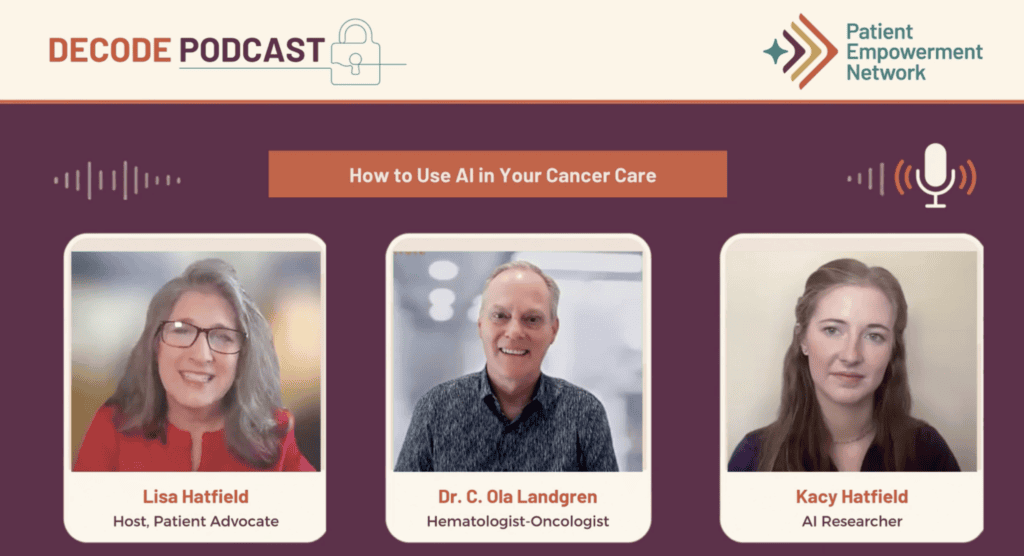
In two episodes of Patient Empowerment Network’s (PEN) DECODE podcast series, How To Use AI in Your Cancer Care and How AI Is Shaping Your Cancer Care, PEN Empowerment Lead and host Lisa Hatfield speaks with Dr. C. Ola Landgren, Director of the Sylvester Myeloma Institute at Sylvester Comprehensive Cancer Center, University of Miami, and Kacy Hatfield, an AI researcher at Arizona State University’s HEART AI Lab.
Together, they explore how patients can use AI to better understand health information, prepare for conversations with their healthcare teams, and navigate important questions about privacy, accuracy, and the future of cancer care.
Here are five strategies from their conversations to help patients and care partners navigate AI with greater knowledge and confidence.
1. Use AI to Prepare for More Productive Conversations With Your Healthcare Team
AI tools such as ChatGPT, Claude, and Gemini can help you make sense of unfamiliar medical language, explore treatment-related questions, and organize information before appointments.
If you’ve recently been diagnosed with cancer, understanding laboratory results, treatment options, or clinical trial information can feel overwhelming. AI may offer a useful starting point as you explore these topics.
Dr. Landgren shares that patients increasingly arrive at appointments having already consulted AI about their care. He welcomes these questions but emphasizes that AI may overlook details that are important to an individual patient’s situation.
Although AI can summarize information and compare options, an experienced healthcare professional brings clinical judgment, knowledge of the patient’s medical history, and an understanding of which information is most relevant.
DECODE Takeaway: Use AI to explore questions and prepare for appointments, but discuss the information with your healthcare team before making decisions about your care.
Questions to Ask Your Healthcare Team:
- I used AI to learn about my diagnosis. Can we review what I found?
- Are the treatment options AI suggested appropriate for my situation?
- What factors in my medical history are most important when considering these options?
Explore the Podcast: How To Use AI in Your Cancer Care
2. Ask Better Questions Using the CRAFT Framework
The usefulness of an AI response often depends on how a question is asked. Kacy Hatfield introduces the CRAFT framework, a practical approach to making AI questions more specific and the resulting information easier to understand.
CRAFT stands for:
- Context: Provide relevant background, such as your cancer type or the general topic you want to understand, without sharing identifying information.
- Role: Tell AI what perspective to use, such as acting as a patient educator.
- Ask: Be specific about what you want AI to explain, compare, or summarize.
- Format: Request information in a way that works best for you, such as a short list, comparison table, or plain-language explanation.
- Tune: Ask follow-up questions to clarify or refine the response.
For example, rather than asking AI, “What does my cancer diagnosis mean?” a patient might ask:
“Act as a patient educator. Explain what stage IIIB non-small cell lung cancer means in plain language. Describe the general types of treatment that may be considered and provide five questions I can discuss with my oncologist. Please avoid medical jargon.”
You can use this approach to better understand medical terminology, prepare questions about treatment, or explore how different tests are used in cancer care. However, more detailed prompts do not guarantee medically accurate answers.
DECODE Takeaway: Be specific about what you want to learn, request information in a format you understand, and use follow-up questions to make the conversation more useful.
Questions to Consider When Using AI:
- Am I asking AI to explain information or make a medical decision for me?
- Have I requested a clear, understandable explanation?
- What questions from this response should I bring to my healthcare team?
Go Deeper With DECODE: Explore the Decoding AI and Your Cancer Care Resource Guide.
3. Recognize AI’s Limitations and Verify Important Health Information
AI can produce convincing responses, even when the information is incorrect. Kacy explains that these errors, often called AI hallucinations, can occur when a system generates inaccurate information and presents it with confidence.
Dr. Landgren describes encountering AI-generated research references that appeared legitimate but did not actually exist.
Another important limitation is that AI may rely heavily on older published information. In rapidly evolving fields such as oncology, newer treatment approaches or research findings may not be fully reflected in an AI-generated response.
This is especially important if you’re using AI to explore emerging therapies, clinical trials, or treatment options that require specialized medical expertise. AI systems can also reflect biases present in the information used to train them, potentially affecting the quality and relevance of their responses.
DECODE Takeaway: Treat AI-generated medical information as a starting point for further learning, not as a verified source of personalized medical advice.
Questions to Ask Your Healthcare Team:
- Is the information I found consistent with current treatment guidelines?
- Are there newer studies or treatment options I should know about?
- How does this information apply to my specific diagnosis and medical history?
4. Protect Your Personal Health Information When Using AI
You may be tempted to upload laboratory results, pathology reports, or other medical records to AI platforms for help interpreting complicated information. But sharing personal health information with public AI tools raises important privacy considerations.
Kacy explains that public AI platforms do not necessarily operate under the same privacy protections as healthcare systems. Information entered into these tools may be stored or used according to each platform’s policies and settings.
She encourages patients to be thoughtful about what they share, remove identifying details when appropriate, and review privacy policies and available data controls.
Dr. Landgren also emphasizes the importance of protecting personal information when using AI. The conversation distinguishes between public AI tools and technologies used within healthcare institutions, including AI scribes that help clinicians document appointments.
If AI tools are being used during your care, it’s important to understand how your information is handled and what choices you have about their use.
DECODE Takeaway: Protect your privacy by limiting the information you share with public AI tools and understanding how your data may be collected, stored, and used.
Questions to Ask Your Healthcare Team:
- Is AI being used to document or support my medical care?
- How is my health information protected when these tools are used?
- Can I choose whether an AI tool is used during my appointment?
Explore the Podcast: How AI Is Shaping Your Cancer Care

5. Understand How AI May Shape More Personalized Cancer Care
Beyond helping patients find information, AI is increasingly being studied as a tool to support cancer research, diagnosis, and treatment decisions.
Dr. Landgren describes how AI may help researchers identify clinical trials, recognize patterns that could support earlier diagnosis, and develop models that predict how individual patients may respond to certain treatments. Traditionally, cancer treatment outcomes are often described using averages or median results from groups of patients.
In the future, AI may help researchers make more individualized predictions by considering factors such as your cancer’s biology, treatment history, and other clinical characteristics.
Dr. Landgren highlights research exploring how AI can analyze bone marrow biopsy images to identify genetic characteristics of multiple myeloma. His team has developed a system called CORAL, which uses biopsy images to predict genetic subtypes of the disease. This research could help researchers better understand differences between patients and eventually support more personalized treatment decisions.
While these advances show promise, AI-supported approaches must be carefully evaluated and used alongside clinical expertise.
The experts also emphasize the importance of ensuring that AI tools work effectively for patients from different backgrounds and healthcare settings. Because AI systems learn from available data, historical gaps in research participation and differences in data quality may influence how well these tools perform across patient populations. Addressing these challenges is essential to making AI-supported cancer care more equitable.
DECODE Takeaway: AI may help advance more personalized cancer care, but it’s important to understand how these technologies are being developed, evaluated, and used alongside clinical expertise.
Questions to Ask Your Healthcare Team:
- Are there AI-supported tools being used to help guide my diagnosis or treatment?
- Could AI-assisted clinical trial matching help identify research opportunities for me?
- How do researchers know whether an AI tool is reliable for patients with my diagnosis or background?
Continue the Conversation: Explore PEN’s DECODE Resources
Understanding how AI can support your cancer journey starts with knowing what questions to ask, where to find trustworthy information, and when to turn to your healthcare team for guidance. Continue exploring how AI is changing cancer care with these two DECODE podcast episodes and the companion resource guide:
- How To Use AI in Your Cancer Care
- How AI Is Shaping Your Cancer Care
- Decoding AI and Your Cancer Care Resource Guide
Stay Informed and Empowered Throughout Your Cancer Journey
Whether you’re newly diagnosed, navigating treatment decisions, or supporting someone you love, having access to understandable, trustworthy information can make a meaningful difference.
AI may help you explore questions, better understand medical information, and prepare for important conversations. But you don’t have to navigate these tools or your cancer journey alone. Stay curious, protect your personal information, and work with your healthcare team to make informed decisions about your care.
Stay connected with PEN for free cancer education, expert insights, and practical resources designed to help you take an active role in your care. Subscribe to receive the latest programs and resources.