
Lung cancer researcher Dr. Erin Schenk shares how recent advances are expanding treatment options for small cell lung cancer patients, from innovative immune-based therapies to promising treatments now being studied in clinical trials. Dr. Schenk also discusses the key tests doctors use to guide care and explains why experts are optimistic about what’s ahead for small cell lung cancer.
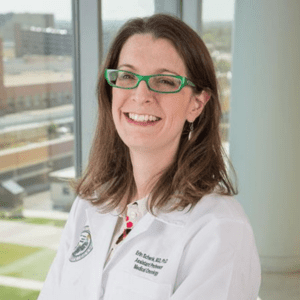
Dr. Erin Schenk is a medical oncologist, lung cancer researcher, and associate professor in the Division of Medical Oncology at the University of Colorado Anschutz Medical Center. Learn more about Dr. Schenk.
Related Resources


Transcript
Katherine Banwell:
Dr. Schenk, there have been promising developments in small cell lung cancer in recent years.
Can you tell us about the latest advances in treatment and research?
Dr. Erin Schenk:
Absolutely. And this is really exciting for those of us who take care of patients with lung cancer, including small cell lung cancer. There’s been a very exciting growth in options available right now in the clinic, as well as options that I hope are soon to come and be widely available for patients. The first option that I’d like to highlight that’s available now is a medicine called tarlatamab-dlle (Imdelltra). Tarlatamab is a medicine that is able to be given if the cancer recurs. So, if a patient has extensive stage small cell lung cancer, and the cancer comes back, tarlatamab is now an option for patients to consider. Tarlatamab is a really new type of immunotherapy or immune-based therapy, where the medicine works to bridge between the cancer cell and the immune cell.
So, one part of the tarlatamab medicine recognizes a marker on the surface of the cancer cells, and the other end of the tarlatamab medicine binds to and recognizes components of the immune system, T cells, to bring the T cells closer together with the cancer. And what happens is that the T cells are then able to get activated and recognize the cancer cells and eradicate the cancer cells. So, that’s one new development that’s very exciting. Studies are going on right now to see if we can use tarlatamab maybe right away when patients are diagnosed. So, more of that information to come, but right now, it is available if the first set of medicines that patients are treated with are no longer effective or didn’t work. The other area of excitement is medicines called antibody drug conjugates.
And there are quite a few that are being explored within small cell lung cancer that I think hold a lot of promise. We sometimes call antibody drug conjugates, we’ll say smarter chemotherapy medicines.
And what I mean by that is, these molecules are designed to recognize surface markers on the cancer cell, bind to the cancer cell, and then deliver a chemotherapy medicine to the cancer cell. There are several antibody-drug conjugates that are advancing with a lot of promise through clinical trials. They’re going after various sets of markers, and I look forward to being able to use these in regular clinical practice soon for patients with small cell lung cancer.
Katherine Banwell:
Dr. Schenk, what testing is essential for people diagnosed with small cell lung cancer? And is biomarker testing necessary?
Dr. Erin Schenk:
I wish that in-depth molecular testing could give us more information for all patients with small cell lung cancer.
Right now, our knowledge of small cell lung cancer and different markers that help some people do well or maybe other people don’t do as well, those are still in research development, so we’re still working on those biomarkers to help us better stratify or identify patients who might do better with one subset of medicines or another.
The understanding of some of this biology of small cell lung cancer is still trying to catch up to the knowledge that we have in non-small cell lung cancer, but for right now, some of the most important tests that your doctor or your team can do for you if there’s a diagnosis of small cell lung cancer is ensuring that they have a very good picture of your whole body or your loved one’s entire body.
And what I mean by that is, often, we need to make sure that there isn’t any cancer that has spread to the brain. That is one of the concerns with this type of cancer. So, we always do MRIs of the brain to make sure we know the lay of the land, we know what we’re starting with, and then full imaging of the body. That can be a CT chest, abdomen, pelvis, but usually, we prefer a PET scan or a special scan with a sugar molecule that can go to very metabolically active or very high-energy parts of the body. That often recognizes where the cancer can be, and that’s a really critical piece for patients with small cell lung cancer. That can help us identify cancer spots that might be quite small, but still in other parts of the body.
Katherine Banwell:
Dr. Schenk, what do you want the audience to know? Are you hopeful about the future of small cell lung cancer care?
Dr. Erin Schenk:
Yes. It has been a really exciting time to be involved in clinical trials for patients with small cell lung cancer and taking care of patients with small cell lung cancer. Because I now have so many more options to help patients with, whether that’s the current medicines, the new medicines coming out, like tarlatamab-dlle (Imdelltra), whether that’s some clinical trial medicines, such as antibody drug conjugates. There are quite a few options being developed and I think will become more available to all patients. So, right now, there are a lot of reasons to consider clinical trials, to consider additional treatments, because we are developing better medicines to control and keep the disease in check.